White Lines Dance
content-video.php
Student Thesis – Pop Bike by Qijing Zhang
View Thesis Paper | Brian’s NYU Student Projects
The goal of Pop Bike was to create a real-time picture of the use of Citi-bikes in NY. Qijing made the project even more interesting by adding useful meta-data, including income-by-census tract, bike-routes and information about public transit.
It was one of the most fun projects I’ve ever supervised, both technologically and conceptually. Qijing was (and is) obsessed with data visualization, and put an enormous amount of effort into learning all that she could about it. Her paper includes a really solid summary of the history of data visualization, in itself an impressive accomplishment but more so considering that English is her second language.
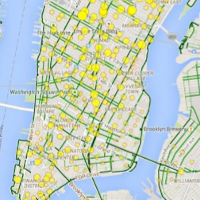
Unfortunately, Qijing’s project isn’t functional right now because of a change in APIs. I’m confident that I will be able to help her fix that with a tiny amount of effort. Its worth preserving.
Student Thesis – Beijing Memories
View Thesis Paper | Brian’s NYU Student Projects
This piece is a reflection on the rapid change which Stacey’s neighborhood in Beijing has undergone during the past two decades. Stacey has gone on to a successful career as an animator and special effects artist.
Student Thesis – My Taiwan
This is a charming animation Pei-Wen Lo produced under my supervision.
Innovation Lab Sample Projects
Analysis of Male Sexual Assault Data
Dr. Kristina Jones, a psychiatrist and researcher, is working on a project that analyzes legal, political and clinical data related to male sexual assault. Students will work with me, and her, on innovative ways to present and analyze this research.
Visualization and Analysis of War Trauma Research Dr. Adeyinka Smith, a psychologist and researcher, is working on several projects related to war trauma and female genital mutilation. Students will work with me, and her, on innovative ways to present and analyze this research.
Creation of a Visual Interface for Narratives Associated with Survivors of Torture
A large number of discrete stories of victims of human rights abuses have been recorded. This project seeks to create an interface to these stories. Example interface designs include Humans of New York (http://www.humansofnewyork.com/) or an interface based on Google Maps. Although students may seek out their own subjects to record, I have found two video artists who have an award winning body of work who have expressed in interest in working with students on their own “bearing witness” project.
Creation and Assessment of a Questionnaire App for Standard Intake Questionnaires (PHQ, HTQ, etc)
Many human rights organizations working with trauma patients use manual intake procedures. This project involves the design and implementation of an Android application that directly writes to a database back-end, thereby reducing redundant work, and reducing the need to keep paper records.
This project has a design and software development component.
Extension of an Intake Interview Application to Include Geo-location Data Tied to Torture and Other War Crimes Narratives
Every year approximately 70,000 refugees are assessed by human rights workers. A simple, web-based touch screen interface to Google Maps could simply collect information of direct relevance to the quantification, assessment and prosecution of war crimes. Such a tool could also be used to provide external verification of refugee claims, and thereby assist refugees during the asylum process.
This project has a design, software development and advocacy component.
Creation of a Crowd-sourced Data Collection Tool
One of the most important recent developments in human rights work has been the wide-spread use of crowd-sourcing tools that are used to bear witness to crimes, and to collect forensic evidence that can be used both in clinical practice and in the prosecution of criminals. The following link to a sexual assault data collection tool provides an excellent template for a possible term project:
Voice Recording and the Clinical Intake Process
Researchers frequently emphasize the importance of engagement, empathy and attention of therapists when engaging with clients. The manual recording of intake interviews interferes with this process. This project would assess the utility of using a voice recognition system, for example Dragon by Nuance or Cortana by Microsoft, to transcribing an intake narrative.
Voice Analysis in the Clinical Intake Process
Considerable research has been done on the semantic analysis of the speech of Alzheimers and autistic patients, with a view to increasing the accuracy of diagnoses. Surprisingly little research has been done with trauma patients. This project involves summarizing research done on voice analysis in the area of clinical diagnosis, and creating a prototype application that could be used for further research in this area.
Creation of a Real-Time Tool for Providing Variance Analysis of Assessment Test Takers
Currently there is a separation between the data collection and analysis tasks at trauma clinics. This project involves designing and implementing a tool that takes clinical intake questionnaire data and integrates it with data relating to an existing population of torture survivors in order to provide real-time T-Tests (and other variance analyses) to show how a particular patient’s responses relate to the overall population of patients at the clinic.
This project involves the cooperation between software developers, statisticians and designers.
Assessment of the Relative Value of D3 and Google Maps as Mapping Tools for Human Rights Advocacy Work
One of the goals of the Lab is to teach students who have an interest in human rights work about data visualization tools. This project involves a critical assessment of existing data visualization libraries.
Critical Assessment and Integration of Existing Advocacy Tools
Organizations such as Human Rights Watch and the American Civil Liberties Union have created tools designed to monitor police brutality and state terror, as well as collect forensic information for litigation, war crimes prosecution and asylum applications. Students participating in this project would assess these tools and suggest ways in which they way be integrated and / or enhanced.
Creation of a Standardized Structure for the Collection, Aggregation and Analysis of Torture Data for Centers for Survivors of Torture
The association that handles the aggregation of torture data in the United States currently uses excel spreadsheets for information interchange. This project involves creating a JSON/SQL based web interface that handles the reading and writing of this data, in order to dramatically improve the efficiency of this process. This project has a design, computer science and advocacy component.
Innovation Lab Syllabus
Course Outline | Innovation Lab Home
Overview
The Innovation Lab being taught this fall will be an exercise in inter-disciplinary teaching that will bring together students interested in data visualization, mapping, software development, clinical psychology and human rights advocacy work.
The pre-interview video gives visual examples of the content and goals of the class.
Who can attend?
The class is open to all students, but will be particularly beneficial to those interested in human rights advocacy work, data visualization, design, mapping, mobile app development, web app development, and the clinical treatment of victims of human rights violations.
No prior knowledge of psychology, design or computer programming is required.
Course Work
Each week students will be assigned approximately 10 hours of work divided between eadings and/or research on one technical issue relating to interface design, data visualization, mobile and /or web application development, readings on issues in clinical psychology and work on your final project.
Grades
Your grade will have 4 components:
- Participation: 20%
- One multi-media presentation on an inspirational technology: 20%
- One multi-media presentation on a human rights issue by country or region: 20%
- One final group project: 40%
The main focus of the class is the final project, which will be a multi-media inter-disciplinary group project that solves an actual problem related to the clinical, advocacy and/or research work of a human rights organization.
Workshops
There will be 4 workshops related to technology, design and psychology issues of relevance to the students’ group projects. As well, I will be available for up to six hours each week to assist students with their projects.
- Interface Design
- Overview of common data visualization tools
- Psychological and neurobiological theories of PTSD
- Flashbulb memories, forgetting and false memories
Class Summary
Classes are divided into two streams. On Tuesdays we will discuss human rights problems and on Thursdays we will discuss technological solutions to these problems. The “problems” section of the class will begin with an overview of the treatment of victims of human rights violations, and then discuss major areas of human rights violations including political oppression, LGBT rights, and sexual violence. To lend coherence to this approach, class discussions and course work will be placed within the context of the bio-psycho-social theory of patient care, discussed by Dr. Kristina Jones in the first workshop. The “solutions” section will begin with an overview of current technological developments, and then will feature case studies on the use of data-visualization, mapping, social media, video, and mobile applications in advocacy and clinical work. The term project is intended to bring these two streams together.
Assignment 1: Presentation on a Human Rights Issue
A 15 minute presentation on a human rights issue. Students will be asked to provide a background to the issue, discuss specific problems related to the issue, summarize academic or political debates related to the issue. The presentation should use multiple media, for example words, pictures, audio and / or video, to illustrate the issue. After the presentation students will provide me with their materials, and work with my to attach them to the class “Human Rights” global map.
Assignment 2: Presentation on an Inspirational Website, Technology or Campaign
A 15 minute presentation on an inspirational (either negatively or positively) website, technology or campaign. This multi-media presentation will have 4 components:
1. A critical evaluation of the interface of the website, technology or campaign. This discussion will develop the work done in the design workshop, including an assessment of whether the manner in which the information is presented appropriately illustrates what is being presented? Does the interface enhance or obfuscate the material? Is the interface intuitive or difficult to use?
2. A critical evaluation of the content of the website. If the site presents evidence, is that evidence creditable? Is the evidence opaquely or transparently presented (can users assess its quality)?
3. Exogenous (external) assessment. What is the context within which the site/technology operates? Could it benefit from being integrated with other tools or campaigns?
4. Endogenous (internal) assessment. Are there ways in which the content could be enhanced to make it more impactful? Are there additional materials or tasks that could be added to the site or campaign to make it more effective?
Term Project
The term project is a multi-media, multi-disciplinary group project that solves an actual problem faced by a human rights organization. I have prepared templates for projects that students are encouraged to work on. HOWEVER if you have a particular problem that you would like to solve, that is relevant to the goals of this course, then please let me know and perhaps your group can work on it.
What follows is a list of project templates that I have already created for this course. No student needs to have a complete mastery of the material required for the completion of these projects. That is why groups must be multi-disciplinary. My job will be to fill in the gaps.
Although students may choose to work in groups, marks will be assigned on an individual basis.
Projects are expected to be multi-disciplinary, combining a technological, psychological, design, data-visualization and / or research component. The are also expected to be multi-media, and therefore will have a written and a visual component.
By the end of September each student, or group of students, will present me with a project plan with four main components:
1. A statement of the goal of the project, specifically what problem the project seeks to solve, and the means by which this will be done.
2. A list of major tasks associated with this project and an estimated timeline In group projects, all tasks will have a project owner.
3. A statement of the main disciplinary focus for each student, for example psychology, design, application development and data-visualization.
4. A statement of secondary disciplinary foci for each students.
75% of the students’ grade will be based on the work done in the main discipline and 25% will be based on the ancillary disciplines. The idea is that each student will have a main strength, for example clinical psychology or software application development, that will be the main thrust of their work on the final project. Work done in this discipline will be graded according to the level of the student (junior sophomore etc). As well, students will be asked to “take a risk” and learn something about additional disciplines, for example psychology for computer science students and design for psychologists. A professional level of output will be expected of this additional work, but less quantity will be expected. For example, psychologists may do a detailed design critique of a web site, but will not be expected to design and implement a complete data management system. The goal is to broaden the students’ horizons, not to overwhelm them with unfamiliar material.
My role will be to act as a type of utility infielder who will work with students to assist them with material that they find challenging. For example, if students with a psychology focus choose to design an interactive web page, I will assist them with the more difficult parts of the web page and ensure that it works, allowing the students to focus on design and content. However, students be will expected to have a general understanding of all parts of the project.
Sample Projects
Please see the Sample Projects document for examples of suitable topics for your final project.
Course Outline
The class outline is a separate series of documents
Guest Speakers
A number of guest speakers have been tentatively scheduled, including clinical psychologists, videographers and survivors of torture.
Attendance and Participation
Students are allowed to miss one class per term without penalty or explanation. Students will be penalized by half a letter grade (A to A-) for every two additional unexplained absences.
Student participation is critical to the success of this class. Credit is given for:
- constructive criticism.
- references to material of relevance to co-students’ work (including web pages, art installations, primary and secondary research materials, and other academic works).
- comments that initiate class discussion.
Flippant, rude, racist and sexist comments are discouraged and will lead to academic penalty. Light-hearted and tangential comments are encouraged, provided they enrich the class discussion and make the learning process more enjoyable. Comments that provoke discussion will improve the participation grade.
Marks will be deducted for the use of email, texting and social media tools in class. Web searches related to topics of discussion are allowed, but should not disrupt the class.
Submission of Written Work
Written work, and multi-media presentations associated with presentations, must be submitted to me at brianmacmillanteacher@gmail.com prior to the commencement of the class, on the day the work is due. Accepted document formats are Microsoft Word (doc or docx), Open Office, PDF, and/or PowerPoint formats, as appropriate. Other file formats may be used with the permission of the Instructor.
Office Hours
I will be available two hours before class on Tuesdays and Thursdays in room 118A Heimbod, or by appointment.
If you have questions please feel free to contact me at bmacmillan@sarahlawrence.edu or at brianmacmillanteacher@gmail.com.
Appendix A: Grading Criteria for Final Project
A Excellent
The work clearly differentiates itself from other work. The work has memorable impact, and pursues concepts and techniques above and beyond original goals. The ideas behind the work are original, thoughtful and/or imaginative. Spelling, punctuation or grammatical errors are non-existent. The work demonstrates the student’s ability to think critically and work independently. The work also demonstrates the student’s use of strong methods and process.
B Very Good / Good
The work is better than average and shows extra effort. The impact of the work is good, and demonstrates the use of an iterative production process. The work employs above average craft and attention to detail.
C Satisfactory
Average and competent, the work has acceptable levels of impact and conceptual development. The content of the work is sufficiently developed, but it lacks thoughtful, original, and imaginative resolution and/or attention to detail and craft. The work employs process, but does not demonstrate notable solutions.
D Poor / Below Average
The work is lacking in many or most areas that show any understanding of the research, design, and/or prototyping phase(s). The impact of the work is weak with unsound, unoriginal, or unimaginative thinking. Problems may include lack of interest, procrastination, poor planning and/or poor craft.
F Unacceptable
The work shows no overall understanding of the research, design, and/or prototyping phase(s) on many levels or either a severe lack of interest.
Appendix B: Grading Criteria for Written Work
Written work is graded according to the following criteria:
| Criterion | Weight | Guidelines |
| Structure | 25% | A – Topic was clearly introduced, subsequent ideas were well developed; the development of ideas occurred in a coherent manner; the conclusion succinctly summarized the content. B – Submission met most but not all of the criteria outlined for an A. C – Submission did not have an introduction and conclusion; ideas were not developed in a logical fashion; points were made in a disconnected way. D – Submission was disorganized and somewhat illogical. F – Submission was incoherent; topic was never introduced; ideas, if presented at all, were not developed. |
| Content | 75% | A – Content was topical and/or interesting; arguments were supported by properly documented evidence; evidence was creatively/critically evaluated; language was clear, concise and grammatical. B – Content met most but not all of the criteria outlined for an A. C – Content met some of the criteria for an A, with significant issues like undocumented sources, unsubstantiated claims, etc. D – Content was unoriginal or trivial, some factual claims were not substantiated, language was ungrammatical. F – Content was incoherent, factual claims were never substantiated, language was ungrammatical. |
Note on Grammar
Although I am not a stickler about typos, passive sentences, oxford commas and split infinitives, I will deduct marks for egregiously incorrect grammar, redundancy and the inexact use of language. Marks are also deducted for informal (idiomatic) writing, and for rude, flippant, racist, sexist or homophobic content. Marks are awarded for succinct, clear, evidence-based arguments.
Appendix C: Grading Criteria for Presentations
Presentations are graded according to the following criteria:
| Criterion | Weight | Guidelines |
| Poise | 25% | Did you address the audience? Did you speak clearly? Did you use intonation to emphasize your points? Did you present yourself well, or did you slouch, wander or dissemble? Did you speak at a volume level appropriate for the venue? A – Presenter had good posture, spoke clearly, used correct, non-idiomatic English, and did not distract the audience with her/his body language. B – Presenter met most but not all of the criteria outlined for an A. C – Presenter met some of the criteria for an A, but for the most part did not. D – Presenter wandered, dissembled, slouched, was difficult to hear, or too loud. F – Presenter was obnoxious, incomprehensible, spoke extremely loudly or was inaudible. |
| Multi-media presentation materials (e.g. slideshows, handouts) | 25% | A – Presentation materials enhanced the presentation and/or provided a solid foundation for it. Note that students can receive an A for visually stunning presentation materials that captivate the audience OR for presentation materials that are simple, professionally executed, and provide a solid foundation for the presentation. B – Presentation materials met most of the criteria for an A but were somewhat facile or distracting, or not professionally executed. C – Presentation materials somewhat distracted from or otherwise undermined the presentation. Presentation materials were sloppily executed, but comprehensible. D – Presentation materials distracted from or otherwise undermined the presentation. Presentation materials were sloppily executed and somewhat incomprehensible. F – Presentation materials were non-existent or poorly executed to the point of being incomprehensible. |
| Criterion | Weight | Guidelines |
| Structure | 25% | A – Presentation topic was clearly introduced, ideas were well developed, the development of ideas occurred in a coherent manner, the conclusion succinctly summarized the content. B – Presentation met most but not all of the criteria outlined for an A. C – Presentation did not have an introduction and conclusion, ideas though presented, were not developed in a logical fashion. Points were made in a disconnected way. D – Presentation was disorganized and somewhat illogical. F – Presentation was incoherent, topic was never introduced, ideas, if presented at all, were not developed. |
| Content | 25% | A – Content was topical and/or interesting; arguments were supported by properly documented evidence; evidence was creatively/critically evaluated; language was clear, concise and grammatical. B – Content met most but not all of the criteria outlined for an A. C – Content met some of the criteria for an A, with significant issues like undocumented sources, unsubstantiated claims, etc. D – Content was unoriginal or trivial, some factual claims were not substantiated, language was ungrammatical. F – Content was incoherent, factual claims were never substantiated, language was ungrammatical. |
Undergraduate Policy on Academic Integrity
Academic work is a shared enterprise that depends on a commitment to truthfulness. SLC students are expected to abide by the standards of intellectual integrity that govern the broader academic community to which the College belongs. These standards entail acknowledging the origin of the ideas, data, and forms of expression that one employs in one’s own work; giving due credit to the sources from which one has borrowed; and affording one’s reader a means of consulting those sources directly. Different academic disciplines may have varying conventions of citation and acknowledgment, and electronic media have increased the availability of oral and printed sources. Students are expected to consult faculty members, library staff, and academic style manuals for specific, up-to-date guidelines on citation.
In addition to the true representation of an individual’s work, academic integrity requires that students not abet others in any misrepresentation of their work. It also requires that students not interfere with the access of other students to shared material such as library books, course packets, etc.
Offenses
Offenses against academic integrity include (but are not limited to) the following:
- plagiarism
- failure to properly cite sources
- submitting under a student’s own name work that is not entirely theirs c. cheating or abetting others in the act of cheating
- falsification of information, data, or attributions
- submitting the same work for more than one class, within the same or different semesters, without the express permission of all faculty involved
- stealing or defacing library materials or otherwise rendering them inaccessible to others
Sarah Lawrence College Compact for Mutual Respect
- We are a community, and we respect and advocate for those with whom we live and work at Sarah Lawrence: students, staff, and faculty.
- We support free speech and impassioned discourse.
- We endeavor to inflict no harm on one another. We neither seek to oppress, nor to submit to oppression.
- We practice wisdom with understanding. We reach out to those in need or trouble, knowing that the well being of our fellows affects us all. We acknowledge our failures, and work to be better members of our shared community .
- We work with integrity, honesty and honor in all endeavors across the campus.
- We respect one another’s privacy and boundaries.
- We pledge to support, nurture and celebrate our diversity in all its dimensions, including, but not limited to, race, religion, ethnicity, language, disability, nationality, socio economic background and cultural, gender and sexual identity.
- We seek to keep our campus a beautiful and welcoming place in which we might all live, work and flourish, and we endeavor to leave it in a better state than we found it.
- We are responsible and respectful in our communications, including those on social media.
- We each commit to these principles and pledge to aid other members of our community in upholding this compact.
Accommodations for Students with Disabilities
Sarah Lawrence will make reasonable academic accommodations and provide auxiliary aids and services to assist otherwise qualified persons in achieving access to its programs, services, and facilities in accordance with Section 504 of the Federal Rehabilitation Act of 1973 and Title III of the Americans with Disabilities Act of 1990. Students who need accommodations due to a disability are encouraged to contact the associate dean of studies and disability services in the Office of the Dean of Studies and Student Life.
CONFIDENTIALITY
Discussions are often an integral part of any class session. Students should only self- disclose material they feel comfortable sharing within the context of the class. In this class all information we are given is respected. Please maintain the integrity of classmate communications by keeping these communications confidential.
Trigger Warning: PLEASE READ
Due to the nature of this class, students might have strong emotional/psychological reactions to the course material and /or discussions. Please let the instructor know if you are having negative reactions to the material. If you find that any of the readings cause distress, you have the right to not read the article. Additionally, you have the right to leave class at anytime if the material or discussion is causing distress. If you do so, you will not be penalized in any way, nor will you be expected to discuss the exact nature of your discomfort. The amount you wish to share is entirely up to you. If you find that the material causes significant distress or emotional disturbance, I will be happy to refer you to on campus resources. Please keep in mind, given the type of content we will be reviewing this semester, it would be entirely natural to react emotionally to the material.
Importantly, what might be upsetting to one person may not be upsetting to someone else in the class. Therefore, given the content of the course, it is imperative that we think carefully and thoughtfully about what and how we comment and respond to each other.
Of course, there may be other topics mentioned that unexpectedly cause you to feel upset. If there is something of particular concern, however, please feel free to let me know, and we can discuss how to approach those assignments.
In addition, for counseling services on campus call Health Services: (914) 395-2350 and for general information on PTSD visit: http://www.ptsd.va.gov/
Please remember that this is an academic class. Therefore, we will not be discussing our own mental health histories (or those of our family members and friends)
ACADEMIC INTEGRITY: ALL text within your project should be your own words/analysis unless directly quoting or citing an agency member, website, or informational material. Citations and a reference page must be included for any quotes or paraphrased material in your project.
Statement on Plagiarism Plagiarism is the unacknowledged use of someone else’s work as one’s own in all forms of academic endeavor (such as essays, theses, examinations, research data, creative projects, etc.) which may be derived from a variety of sources (such as books, journals, Internet postings, student or faculty papers, etc.). Students should refer to the Policy on Academic Honesty in the Sarah Lawrence College catalog for full information on the consequences of plagiarism.
I look forward to meeting you!
– Brian MacMillan
List of HTML Colors
AliceBlue#F0F8FF
AntiqueWhitE#FAEBD7
Aqua#00FFFF
Aquamarine#7FFFD4
Azure<#F0FFFF
Beige#F5F5DC
Bisque#FFE4C4
Black#000000
BlanchedAlmond#FFEBCD
Blue#0000FF
BlueViolet#8A2BE2
Brown#A52A2A
BurlyWood#DEB887
CadetBlue#5F9EA0
Chartreuse#7FFF00
Chocolate#D2691E
Coral#FF7F50
CornflowerBlue#6495ED
Cornsilk#FFF8DC
Crimson#DC143C
Cyan#00FFFF
DarkBlue#00008B
DarkCyan#008B8B
DarkGoldenRod#B8860B
DarkGray#A9A9A9
DarkGreen#006400
DarkKhaki#BDB76B
DarkMagenta#8B008B
DarkOliveGreen#556B2F
Darkorange#FF8C00
DarkOrchid#9932CC
DarkRed#8B0000
DarkSalmon#E9967A
DarkSeaGreen#8FBC8F
DarkSlateBlue#483D8B
DarkSlateGray#2F4F4F
DarkTurquoise#00CED1
DarkViolet#9400D3
DeepPink#FF1493
DeepSkyBlue#00BFFF
DimGray#696969
DodgerBlue#1E90FF
FireBrick#B22222
FloralWhite#FFFAF0
ForestGreen#228B22
Fuchsia#FF00FF
Gainsboro#DCDCDC
GhostWhite#F8F8FF
Gold#FFD700
GoldenRod#DAA520
Gray#808080
Green#008000
GreenYellow#ADFF2F
HoneyDew#F0FFF0
HotPink#FF69B4
IndianRed #CD5C5C
Indigo #4B0082
Ivory#FFFFF0
Khaki#F0E68C
Lavender#E6E6FA
LavenderBlush#FFF0F5
LawnGreen#7CFC00
LemonChiffon#FFFACD
LightBlue#ADD8E6
LightCoral#F08080
LightCyan#E0FFFF
LightGoldenRodYellow#FAFAD2
LightGrey#D3D3D3
LightGreen#90EE90
LightPink#FFB6C1
LightSalmon#FFA07A
LightSeaGreen#20B2AA
LightSkyBlue#87CEFA
LightSlateGray#778899
LightSteelBlue#B0C4DE
LightYellow#FFFFE0
Lime#00FF00
LimeGreen#32CD32
Linen#FAF0E6
Magenta#FF00FF
Maroon#800000
MediumAquaMarine#66CDAA
MediumBlue#0000CD
MediumOrchid#BA55D3
MediumPurple#9370D8
MediumSeaGreen#3CB371
MediumSlateBlue#7B68EE
MediumSpringGreen#00FA9A
MediumTurquoise#48D1CC
MediumVioletRed#C71585
MidnightBlue#191970
MintCream#F5FFFA
MistyRose#FFE4E1
Moccasin#FFE4B5
NavajoWhite#FFDEAD
Navy#000080
OldLace#FDF5E6
Olive#808000
OliveDrab#6B8E23
Orange#FFA500
OrangeRed#FF4500
Orchid#DA70D6
PaleGoldenRod#EEE8AA
PaleGreen#98FB98
PaleTurquoise#AFEEEE
PaleVioletRed#D87093
PapayaWhip#FFEFD5
PeachPuff#FFDAB9
Peru#CD853F
Pink#FFC0CB
Plum#DDA0DD
PowderBlue#B0E0E6
Purple#800080
Red#FF0000
RosyBrown#BC8F8F
RoyalBlue#4169E1
SaddleBrown#8B4513
Salmon#FA8072
SandyBrown#F4A460
SeaGreen#2E8B57
SeaShell#FFF5EE
Sienna#A0522D
Silver#C0C0C0
SkyBlue#87CEEB
SlateBlue#6A5ACD
SlateGray#708090
Snow#FFFAFA
SpringGreen#00FF7F
SteelBlue#4682B4
Tan#D2B48C
Teal#008080
Thistle#D8BFD8
Tomato#FF6347
Turquoise#40E0D0
Violet#EE82EE
Wheat#F5DEB3
White#FFFFFF
WhiteSmoke#F5F5F5
Yellow#FFFF00
YellowGreen#9ACD32
Sample Quiz
Each question is worth one mark. You can refer to your notes but you cannot communicate with fellow classmates. If you cheat or provide answers to a classmate you will get zero on the quiz. If your grade on this sample quiz is higher than on a subsequent quiz you may substitute the grade on this quiz for that one.
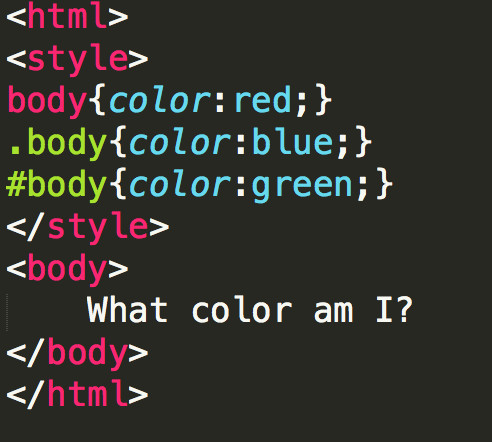
1. What is the color of the text “What color am I”?
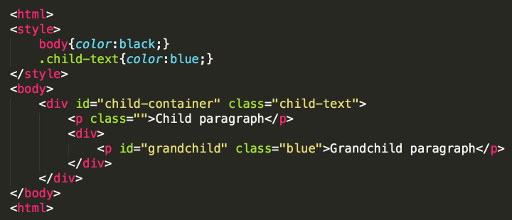
2. In the following example, is the text of the #grandchild element black or blue?
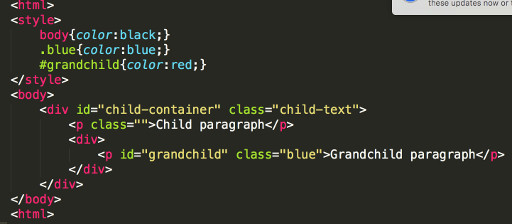
3. What color is the text of the #grandchild element, blue, red or black?
4. How do you apply styling only to the first character of the first paragraph of #child-container?
Submit
Max / MSP
I have considerable experience creating visual art with Max, and modest experience composing music with MSP.
Post format is:
Template archive.php